
This post has been read 56 times!
 November 11, 2026- by Steven E. Greer, MD
The mysterious particulate “fog” people are seeing, and dusty coatings left on cars, etc. is indeed man-made. What it is made of needs to be tested.
Yes, it could be graphene oxide, which is a military technology. Yes. It could also be tiny electrical robots.
This all sounds crazy because the military and their proganda outlets have kept us in the dark to many technologies. However, it is all coming to light over the last year as they use them.
The Origins of Smart Dust
The concept of smart dust originated in the 1990s out of a series of Defense Advanced Research Projects Agency studies and earlier RAND workshop discussions, formalizing into a major research project led by Dr. Kris Pister (with colleagues Joe Kahn and Bernhard Boser) at UC Berkeley. Their 1997 proposal, funded in 1998, aimed to create wireless sensor nodes with a target volume of one cubic millimeter, complete sensing, computation, communication, and power platforms small enough to be dispersed like dust.
Early work produced larger “COTS Dust” motes from commercial components before shrinking toward grain-of-rice scale. The project also generated TinyOS, the lightweight open-source operating system that became foundational for wireless sensor networks. Pister later founded Dust Networks in 2002 to commercialize the technology for industrial and building-automation markets.
How Small Is It?
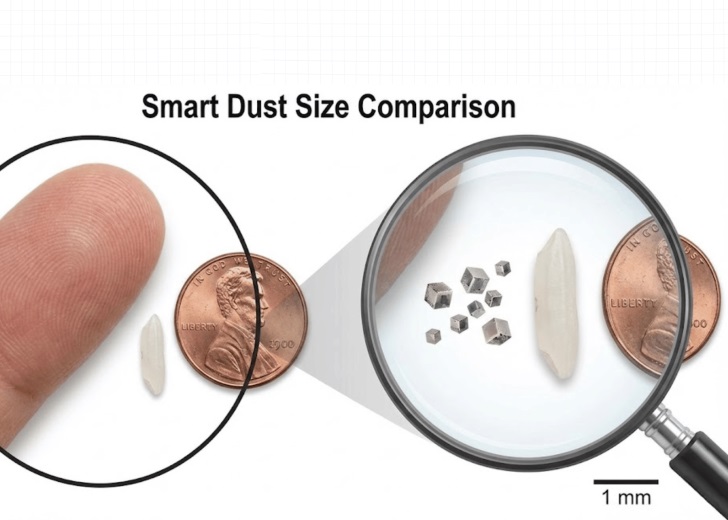
While early conceptual prototypes in the 2000s were the size of a matchbox or a few millimeters, modern iterations have successfully shrunk down to 1 cubic millimeter or less, often described as smaller than a grain of sand or a fleck of glitter. Advanced microfabrication now allows experimental versions to reach sub-millimeter and micron scales, under 500 micrometers (less than 0.5 mm), making them virtually imperceptible to the naked eye.
How It Works Without a Battery
Traditional batteries are too bulky for smart dust. Instead, these motes are engineered with ultra-low-power architectures that operate on nanowatts and rely on ambient energy harvesting or passive power methods. They draw power continuously from their environment through built-in micro-photovoltaic (solar) cells, thermoelectric generators that capture temperature differences, and piezoelectric components that convert ambient vibrations or wind into electricity.
In passive RF or optical systems, similar to RFID tags, a mote can remain completely dormant until a remote receiver interrogates it with a radio wave or laser beam. The mote absorbs that incoming signal’s energy, powers up its circuit instantly, and reflects data back.
To further conserve energy, the devices use duty cycling, spending most of their time asleep and waking only for brief fractions of a second to take measurements or relay information.
How It Communicates
Because individual motes lack the power and space for heavy antennas, they cannot transmit data across long distances directly. They communicate through mesh or multi-hop networking, in which each mote whispers to its nearest neighbors so that data hops from one microscopic speck to the next until it reaches an edge gateway or central base station.
Some systems use passive optical retroreflectors, specifically a MEMS Corner Cube Retroreflector. When a central system such as a helicopter or handheld device shines a laser onto the dust cloud, the retroreflector mechanically tilts its internal microscopic mirrors to modulate and bounce the laser light back, transmitting binary data without generating its own radio waves.
Other designs incorporate tiny active laser diodes with steerable mirrors or micro-antennas that transmit ultra-short-range radio or infrared signals.
What It Can Measure and Capture
Despite their size, micro-machining allows these chips to hold a surprisingly dense array of sensors. A single smart dust mote can measure physical stimuli such as ambient light intensity, temperature, barometric pressure, and humidity; kinematics and inertia including acceleration, acoustic sounds, structural tilts, and minute localized vibrations; and environmental or chemical elements such as magnetic field shifts, gas leaks, toxins, pollution, or chemical traces in the air or soil.
In highly specialized or medical variants known as neural dust, the sensors can monitor interior vitals, glucose levels, or track moving objects externally when interrogated.
Commercial and Financial Applications
Decades after these initial military concepts, the technology has heavily transitioned into the commercial, financial, and industrial sectors, as evidenced by corporate intellectual property filings.
For instance, financial institutions like Wells Fargo have patented applications for the technology. U.S. Patent 11,354,666 B1, filed May 26, 2016 and granted June 7, 2022, describes a conceptual system in which microelectromechanical systems (MEMS) “smart dust” devices would be deployed around a user at a payment terminal or ATM. The motes would collect biometric and environmental data, including heart rate or pulse, blood pressure, body temperature, height and weight estimates, optical images for facial recognition, audio and voice patterns, infrared thermal mapping, electromagnetic fields, motion and gait, air pressure, and location, then compare the readings against a stored user profile to authenticate identity without a card, phone, or password.
The patent remains conceptual; no public evidence exists of operational airborne biometric-dust systems.
Scaled-Up Industrial Use
While highly advanced systems like airborne consumer biometric sensors remain largely conceptual or confined to secure laboratories, scaled-up versions of smart dust are actively utilized across several industries today. These slightly larger, macroscopic versions of the technology provide practical foundations for what will eventually become true nanoscale networks. By deploying these sensors in environments where traditional wiring is impossible, industries are proving the viability of autonomous, low-power data collection on a massive scale.
Structural Engineering and Manufacturing
In structural engineering and manufacturing, micro-sensors are embedded directly into concrete blocks, beams, and building foundations during construction to log pressure variations, internal stress, vibration, tilt, acoustic emissions from cracking, moisture, and temperature over decades. These smart elements allow skyscrapers, bridges, and dams to essentially report on their own structural health from the inside out. Continuous MEMS-based structural-health-monitoring systems, using accelerometers, clinometers, strain gauges, and acoustic-emission sensors, enable dense wireless networks that detect microscopic fissures, seismic damage, prestress loss in tendons, or moisture accumulation. Data is often compared in near-real time against digital-twin finite-element models, supporting anomaly detection, verification of retrofit work, and predictive maintenance that reduces reliance on purely manual external inspections.
Automotive Engineering
In automotive engineering, miniature microelectromechanical systems accelerometers are standard components used to trigger safety mechanisms like airbags by sensing the rapid deceleration of a crash. Advanced tire-pressure monitoring systems rely on MEMS pressure sensors, frequently integrated on the same chip with an accelerometer, mounted inside the tire or on the rim. The accelerometer detects the centrifugal force of the rotating wheel and can serve as a wake-up signal, allowing the pressure sensor to remain in a low-power sleep mode most of the time and thereby extending battery life. Research continues into vibration- and kinetic-energy harvesting (piezoelectric films, electrostatic electret devices, and similar approaches) so that future sensors could operate with minimal or no battery replacement while maintaining constant communication with the vehicle’s central safety array. Monolithic pressure-plus-accelerometer chips already reduce size, cost, and power draw for mass production.
Medical Neural Dust
Furthermore, medical researchers have deployed neural dust, microscopic, wireless, battery-free sensors implanted into human or animal bodies, that rely on ultrasound waves to power themselves and map intricate nerve, brain, and muscle activity in real time.
Developed primarily at UC Berkeley by teams including Michel Maharbiz, Jose Carmena, and Dongjin Seo (with DARPA support under programs such as ElectRx), the motes contain a piezoelectric crystal that converts external ultrasound energy into electricity and simultaneously enables data transmission via acoustic backscatter. Because radio waves attenuate rapidly and can cause tissue heating in deep fluid and organic tissue, ultrasound provides far more efficient power delivery and safer communication.
First demonstrated in vivo in 2016, the roughly 1-millimeter-scale devices successfully recorded electromyogram (muscle) and electroneurogram (nerve) signals in anesthetized rats. Subsequent work has pushed toward still smaller sizes (tens to hundreds of micrometers) and added stimulation capability. Potential applications include chronic neural interfaces for advanced prosthetic limbs, closed-loop “electroceuticals” to treat epilepsy, inflammation, or metabolic disorders, and long-term monitoring without the need for battery-replacement surgeries.
Note: Dr. Greer was a top-ranked medical device analyst at Donaldson Lufkin & Jenrette, Credit Suisse, and Merrill Lynch