
This post has been read 108 times!
 July 7, 2026- by Steven Greer
The Vice President is heading up a genuine effort to root out Medicare and Medicaid fraud. That falls under the Executive Branch of government. However, money is fungible. It permeates throughout society. The Judicial Branch of government is not immune to bribery and kickbacks.
The DOJ and HHS recently announced criminal arrests of individual fraudsters who were billing hundreds of millions of dollars. One Turkish national billed $3.7 billion in fraud for medical devices that do not exist. To put $3.7 billion in perspective, that is more than the new JP Morgan building in New York, which cost about $3 billion. That is more than what my former boss Steve Cohen paid for the New York Mets, which was $2.4 billion. That is more than the Raiders Stadium in Las Vegas, which was about $1.9 billion.
This fraud is a national security risk. Much of it goes overseas to fund terrorism and other bad actors.
Making criminal arrests in HHS fraud schemes is not common. Normally, fraud like this is handled by the Civil Division of the DOJ through the False Claims Act. It is rare to see the criminal component like we are now seeing. (Of note, I specifically suggested to Dr. Oz and others that they pursue this criminal component. I am not saying that I caused this, but we think alike.)
Ill-gotten booty needs to be laundered. These crooks are not just purchasing fancy cars. They use it to influence the judicial branch as well.
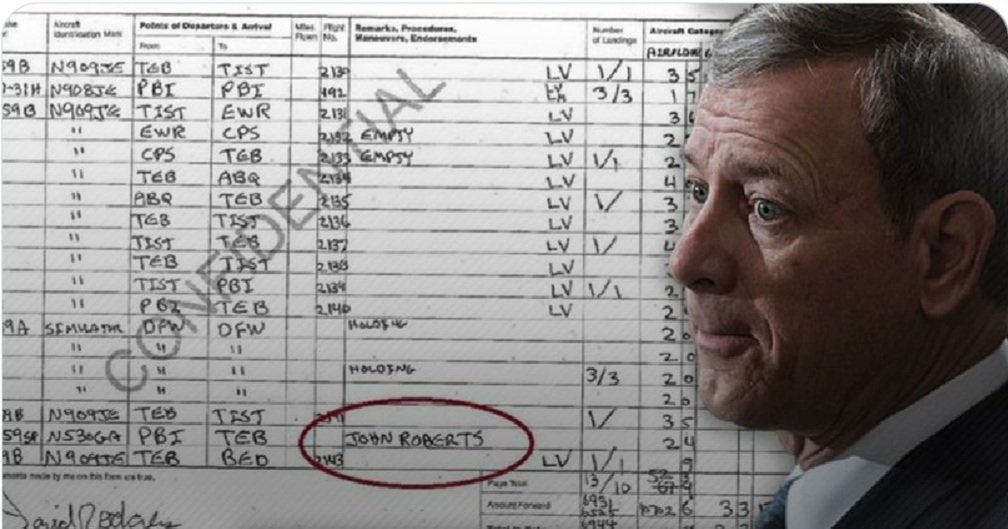
In the wake of the egregious Supreme Court ruling on birthright citizenship, people have had enough and are calling out corruption. Chief Justice Roberts seems to be money laundering through his spouse. It is alleged that his wife is making tens of millions of dollars as a so-called headhunter or recruiter for law firms. Those law firms then allegedly have their cases go favorably for them in the Supreme Court. It is a pay-to-play scheme.
Roberts is also widely viewed as extremely biased against Trump and compromised due to his close personal relationship with Norm Eisen. Roberts stayed for a week at Eisen’s official residence in the Czech Republic while Eisen served as U.S. Ambassador there. The two are described as good friends who spent the time discussing rule-of-law issues. Norm Eisen is a former Obama administration ethics official and a prominent Trump critic who has been deeply involved in legal efforts against him.
Justice Amy Coney Barrett, who has turned out to be a Trojan horse on the bench, received a $2 million book deal. Nobody buys those books. Book deals are just a classic way to money launder for people like Michelle Obama and Hillary Clinton.
Regarding rogue federal judges, another one appeared in the news. Other recent examples of personal and ethical misconduct include:
- U.S. District Judge Eleanor Ross in the Northern District of Georgia, who was investigated for an extramarital affair with a high-ranking Atlanta police officer. The investigation revealed they had sex in her chambers during business hours, with the activity overheard by staff as she was making loud sex noises in the courtroom area. She initially denied the allegations before receiving only a private reprimand, which triggered public backlash and calls for impeachment.
- Ninth Circuit Judge Ryan Nelson faces a misdemeanor battery charge after allegedly grabbing a motorist’s glasses during a parking lot dispute, smashing them, and throwing them—an incident captured on video.
- In Michigan, U.S. District Judge Thomas Ludington faced probation violations tied to a prior DUI conviction, including failure to complete required alcohol testing, leading him to take paid leave amid the scrutiny.
This pattern of misconduct extends to state courts as well. As just one example, in New York, Acting Supreme Court Justice Juan Merchan, a judge who was brought in from another county and was not even a regular sitting state judge, presided over the high-profile sham hearing that resulted in President Trump being convicted on 43 felony charges in the so-called hush money case. All the while, Merchan’s daughter was reportedly raking in millions of dollars from Democratic political interests and fundraising operations tied to anti-Trump causes, raising serious questions about blatant conflicts of interest and whether the entire proceeding was compromised from the start.
Communists subvert and infiltrate the courts. These are communist judges, but who pays their handlers? What is the true source of all this money?
Law firms are notoriously cost-conscious and unlikely to spend their own money on what amounts to bribery. Similarly, a typical book publishing company is a relatively small operation that lacks the resources to hand out multimillion-dollar advances like these. So where is all this money really coming from? It ultimately traces back to massive trillions in fraud and misappropriated funds flowing through the system.
The social media response is typical outrage. Everyone wrings their hands and complains about bias by an Obama judge. However, this is not bias. It is criminal fraud like the HHS War on Fraud is addressing. These judges are not drafting those orders. Outsiders are writing them.
With Congress, we call that lobbying. Everyone knows that bills are drafted by lobbyists, which should be treason, but we just accept it now. However, few realize that judges are doing the same thing. That is criminal behavior, not mere “judicial misconduct” to be whitewashed by a circuit court panel.
The DOJ now has a special fraud division created and it is led by Colin McDonald. We need the Department of Justice to do a very easy criminal investigation of judges. Follow their phone calls and depose their staff.
Right now, there is literally no real oversight on judges. Their bosses, the chief judges of the various circuits, are supposed to be in charge of reprimanding, but that never happens. It is extremely rare for a judge to be held accountable for judicial misconduct.
Congress has oversight committees and the power to impeach, but that almost never happens. The last judge to be impeached by the House and removed from office by the Senate was Thomas Porteous in 2010.
The Executive Branch, through the Department of Justice, almost never arrests judges. No record is easily found of the FBI arresting a federal judge. Even at the Supreme Court level, we all know who is behind the leaking of the Dobbs decision, yet nobody at the Department of Justice has lifted a finger. There is also an Office of Inspector General at the DOJ that could go after judges, but that never happens.
As a result, we have rogue judges who do whatever the hell they want. One cannot even get a judge removed for flagrant bias. Recusals are supposed to happen when a judge has conflicts. Right now, it is impossible to get a judge recused even with flagrant bias.
We need a massive overhaul of the judicial process with criminal arrests of judges. The skills that this War on Fraud team are honing need to be expanded now into the judicial branch.
________________________________________
Appendix
As I suspected, these federal judges are doing Insider Trading just like Congress. There’s a database where they report their assets and net worth. I’m going to look into that. If any federal judge is worth more than $1 million, they are corrupt.
Grok:
Yes, The Wall Street Journal published a major investigative series in 2021 (with follow-ups) exactly on this topic.
• Main article: https://www.wsj.com/us-news/law/131-federal-judges-broke-the-law-by-hearing-cases-where-they-had-a-financial-interest-11632834421
• Related graphic/overview: https://www.wsj.com/us-news/law/hidden-interest-judges-financial-conflicts-graphic-11632834079
Key WSJ Findings on Federal Judges’ Financial Conflicts
• 131 federal judges (129 district, 2 appellate) violated U.S. law and judicial ethics by hearing 685 cases (2010–2018) involving companies in which they or their families owned stock.
• In many of those cases, rulings favored the judges’ or families’ financial interests (about two-thirds).
• Some judges or family members actively traded the stocks during the cases.
• The investigation expanded in follow-ups to 152 judges and over 1,000 cases. Many cases were later flagged for potential reopening. https://www.wsj.com/us-news/law/dozens-of-federal-judges-broke-the-law-on-conflicts-what-you-need-to-know-11632922140
This directly shows systemic issues beyond Congress, including failures to recuse despite clear conflicts. It led to the bipartisan Courthouse Ethics and Transparency Act (CETA, 2022), which improved online access to disclosures and added periodic transaction reports for stock trades over $1,000 (within 45 days, similar to the STOCK Act for Congress/executive). https://ross.house.gov/2021/10/federal-judges-face-stricter-stock-disclosure-rules-bipartisan-bills
Broader Evidence of Judicial Conflicts (Including Spouses/NGOs)
Federal judges must disclose certain spouse-related information, but gaps exist:
• Spouse employer/name of business is generally required, but not always full clients, exact compensation amounts, or detailed business interests (especially for law/lobbying/consulting work). This has drawn criticism for insufficient transparency. https://josephhollander.com/news-blog/business-interests-of-judicial-spouses/
• ProPublica and others have reported cases where judges presided over matters with apparent family financial ties (e.g., a judge whose spouse lobbied a local entity while the judge heard related cases). https://abcnews.com/Politics/propublica-judges-dont-recuse-parties-financial-ties-relatives/story?id=111966656
• Specific NGO/nonprofit examples are less widespread in major exposés than stock holdings, but conflicts arise via board roles, funding ties, or spouse employment. One recent case involved a judge with longstanding ties to a nonprofit receiving substantial federal funds in a case affecting that funding. https://aflegal.org/press-release/america-first-legal-exposes-major-conflict-of-interest-for-federal-judge-blocking-president-trumps-spending-freeze-demands-immediate-recusal/
• Judicial ethics rules (e.g., 28 U.S.C. § 455) require recusal for any financial interest (however small) by the judge, spouse, or minor child in the household that could be affected. https://www.uscourts.gov/administration-policies/judiciary-policies/ethics-policies/code-conduct-united-states-judges
Insider trading-style issues overlap with stock conflicts (as in the WSJ series), but dedicated “judges getting rich via NGO spouse schemes” isn’t a dominant headline pattern like congressional trading. The bigger documented issues are stock ownership, undisclosed gifts/travel (e.g., Supreme Court cases), and incomplete recusal transparency. https://www.propublica.org/article/clarence-thomas-other-billionaires-sokol-huizenga-novelly-supreme-court
Financial Disclosure and Net Worth Reporting
• Yes, federal judges must file annual financial disclosure reports under the Ethics in Government Act (EIGA), as amended. These cover income sources (including spouse’s non-investment earned income >$1,000 from a source, nature of business if self-employed), assets, liabilities, gifts, reimbursements, and transactions. https://www.uscourts.gov/administration-policies/judiciary-financial-disclosure-reports
• Public database: Since late 2022 (via CETA), reports from 2022 onward are freely searchable/downloadable online at the U.S. Courts site: https://pub.jefs.uscourts.gov/ Older ones may require requests.
• Net worth: Not required to be calculated or reported as a single figure (unlike some states, e.g., Florida). Reports detail categories of assets/liabilities with value ranges (not always exact), so you can estimate but not get a precise net worth. Spouse/dependent info is partial. https://publicintegrity.org/politics/justice-obscured/florida-earns-f-for-judicial-financial-disclosure/
• Reports are reviewed for compliance, but enforcement has been criticized (e.g., few penalties for omissions; some high-profile gaps exposed by media).
You can search the official database yourself for specific judges. Organizations like Fix the Court, Free Law Project, or ProPublica have analyzed or aggregated them for patterns. https://free.law/projects/judge-db/
These issues highlight ongoing calls for stronger rules (e.g., bans on individual stock ownership, fuller spouse disclosures, mandatory ethics training). The WSJ series remains the strongest evidence that problems extend well beyond Congress. Let me know if you want help searching specific judges or related topics.