This post has been read 186 times!
 September 26, 2026- by Steven E. Greer
At the UN this week, Benjamin Netanyahu denied Israel had committed genocide in Gaza and called the charge “the greatest lie of the century.” He told the General Assembly the war was “the opposite of genocide,” and that “Israel didn’t commit genocide; Israel prevented genocide.” Delegates walked out before and during the speech.
That is DARVO: Deny the accusation, Attack the people making it, and Reverse the roles of Victim and Offender.
Bibi treated the word “genocide” itself as the outrage. He said that if Israel had not done what it did, Israelis “would all be dead,” and that Hamas would have “killed every last one of us.” The October 7 massacre was real and not an Israeli false flag, he claimed. Using it to erase what followed in Gaza is the reversal.
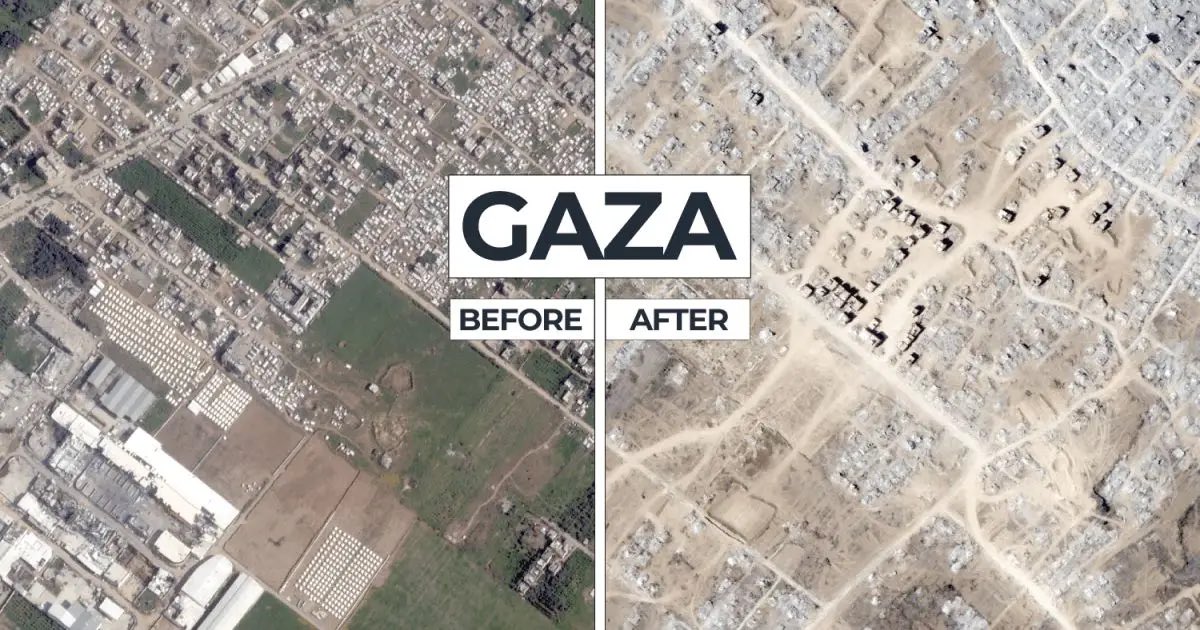
The physical record does not match Netanyahu’s claim that Israel practiced careful self-defense while largely sparing civilians. UN and satellite assessments place the vast majority of Gaza’s buildings in the destroyed-or-damaged column, including roughly 80 percent of all structures and about 90 percent of housing. Furthermore, UN-Habitat’s 2026 urban profile reported that more than 95 percent of neighborhoods were functioning at a low level or worse. The reality is unmistakable: the vast majority of the Strip has been wrecked. According to United Nations satellite assessments, 82 percent of all physical structures have been damaged or demolished across Gaza’s 140 square miles, rendering roughly 100 square miles entirely uninhabitable under the weight of more than 57 million tonnes of debris.
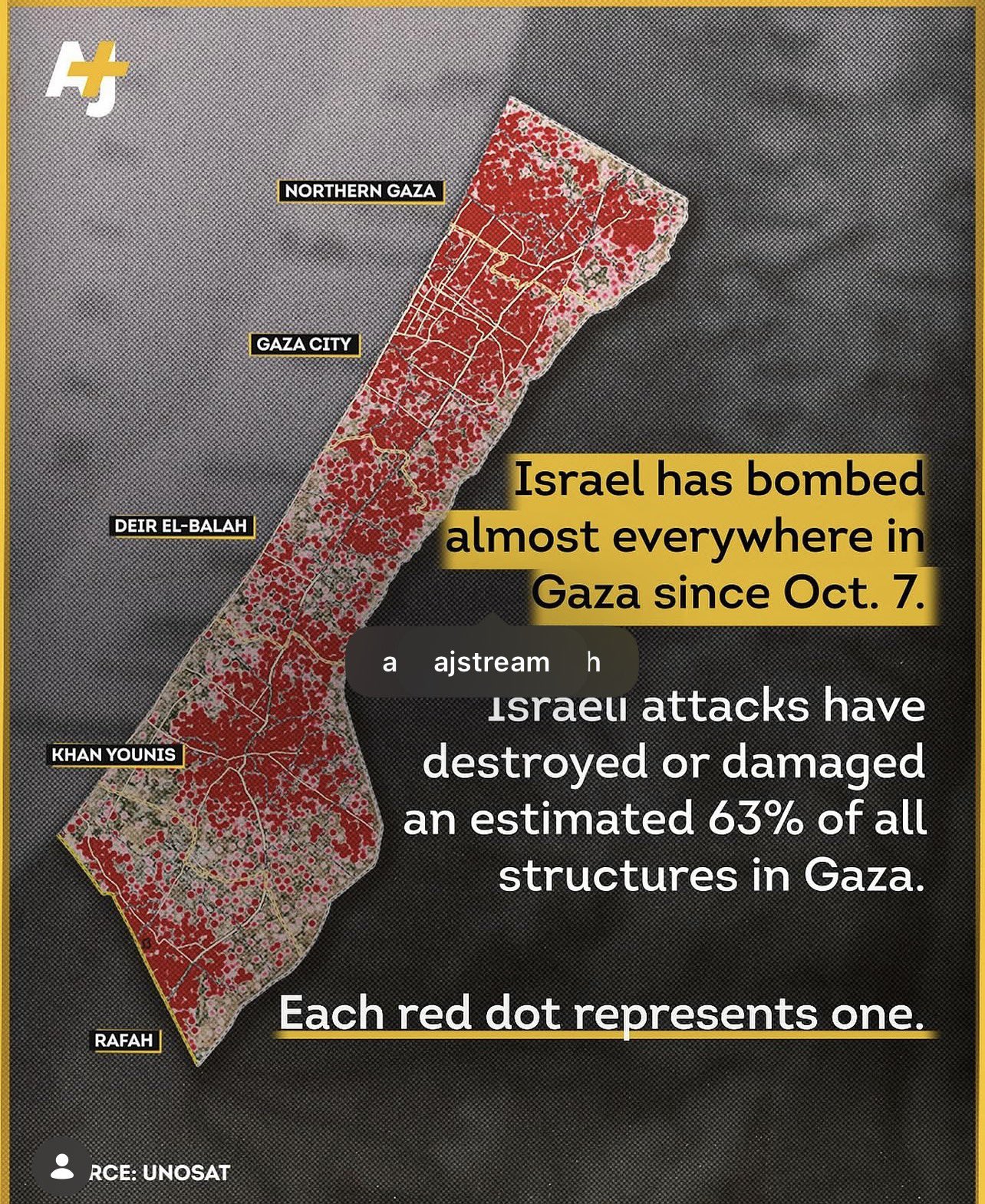 To achieve this level of destruction, an estimated 223 kilotons of conventional munitions were deployed across the territory. This total cumulative force yields a kinetic impact of roughly 260 to 290 kilotons of TNT equivalent, which represents approximately 60 to 90 percent of the explosive power found in a single hydrogen bomb.
Israel dropped an H-bomb on Gaza in slow-drip fashion. Both the Biden and Trump administration provided the 2,000-lbs bombs.
During an appearance on The Daily Show with Jon Stewart, Hollywood mogul and Mossad operative Ari Emanuel asserted that, if he were advising his client Macklemore regarding the backlash over his remarks on Gaza, he would instruct him to acknowledge the “difficult conditions” in Gaza while refraining from using the term “genocide.” Emanuel’s public intervention effectively sought to police acceptable political speech and redirect the discourse away from the scale of the destruction.
This method is old: change the label, keep the facts blurry, and punish the vocabulary. The Soviet Union used missives like “enemy of the people” to end debate. Nazi Germany flipped words like fanatisch from an insult into a virtue. Intelligence services have always planted frames and altered stories to force a single conclusion. Policing the word “genocide” while cities are reduced to rubble is part of that same tradition.
George Orwell argued that changing language changes how people think. Language shapes how the brain works. By cutting words, locking meanings, and replacing plain speech with official phrases, authorities strip away the tools people need to form independent thoughts.
He put that idea in his book Nineteen Eighty-Four, published 8 June 1949. In Book One, Chapter 5, the character Winston eats lunch with the character Syme, who works on the Newspeak dictionary. Syme says: “Don’t you see that the whole aim of Newspeak is to narrow the range of thought? In the end we shall make thoughtcrime literally impossible, because there will be no words in which to express it. Every concept that can ever be needed, will be expressed by exactly one word, with its meaning rigidly defined and all its subsidiary meanings rubbed out and forgotten.”
That speech is the Party’s plan stated outright. Shrink the vocabulary every year. Shrink what people can hold in mind. By 2050, Syme says, no one will even understand a conversation like theirs.
The book’s appendix, “The Principles of Newspeak,” shows how the language is built. “Ungood” replaces a pile of words for bad. “Plusgood” and “doubleplusgood” replace a pile of words for excellent. “Free” still exists, but only for a dog free of lice, not for a person free of the state.
Orwell said the same thing outside the novel. In April 1946, he published “Politics and the English Language.” He wrote that sloppy language makes sloppy thought easier, then added: “But if thought corrupts language, language can also corrupt thought.” He meant political catchphrases. They arrive ready-made. The writer stops choosing words and lets the phrase think for him. Lies sound clean. Violence sounds official.
Orwell did not invent these concepts out of thin air. He saw it firsthand. In 1936, he went to Spain to fight Franco and served with the POUM, a Marxist militia the Stalinists later crushed. In Barcelona, he watched propaganda turn allies into traitors overnight. He recorded that in Homage to Catalonia. Animal Farm and Nineteen Eighty-Four came after that experience.
Following World War II, Orwell noticed this same manipulative pattern bleeding into everyday English. He grew deeply critical of official political speech, which relied heavily on padded phrases, deceptive euphemisms, and prefabricated slogans designed to shut down critical thinking entirely.
The United States used language as a tool too. The Church Committee in 1975–76 (after the CIA’s failed Vietnam War) found that the CIA maintained secret ties to journalists and ran foreign propaganda networks under an initiative known as Operation Mockingbird. The committee officially counted about fifty American journalists with secret Agency links and warned that these operations intentionally misled the public to manipulate domestic and global opinion. Reporter Carl Bernstein (a CIA plant acting as limited hangout) later exposed that the real number over a 25-year period was far higher, involving more than 400 members of the American press who secretly carried out assignments to shape how the public processed major news stories.
The CIA treated news and stories as weapons. After Orwell died, the agency secretly bought the film rights to Animal Farm and altered the 1954 animated movie’s ending. In the book, the pigs and humans become identical, but the CIA’s film changed the climax so the other animals rise up and overthrow the pigs. This edit cut Orwell’s double critique of both capitalism and communism to turn the movie into a simple anti-Soviet propaganda tool.
In Nazi Germany, the regime systematically changed the meaning of existing words rather than inventing a new language. For example, fanatisch previously meant mindless zeal, but the Nazis flipped it to mean loyal and heroic to force their ideology into everyday speech. Similarly, the Soviet Union used rigid labels like “enemy of the people,” “bourgeois,” and “counter-revolutionary” to end political debates; once a label was applied, all discussion stopped.
Orwell’s Newspeak deletes words to kill thoughts entirely. Real spy propaganda instead floods the public with an approved narrative frame until alternatives become impossible to use. Orwell observed both methods. He wrote the extreme version as fiction, but the milder form was already fully active in newspapers, government ministries, and intelligence networks during his lifetime.
Knowing this history, pay attention to those claiming “genocide” did not occur in Gaza despite the equivalent of a hydrogen bomb being detonated. Follow the money. Who now wants to turn Gaza into Las Vegas or Miami?
September 26, 2026-
- Bill Maher and James Kirchick don’t believe there’s a genocide in Gaza. Maher: It is a word in the English language. Kirchick: It really is the biggest lie of the 21st century.
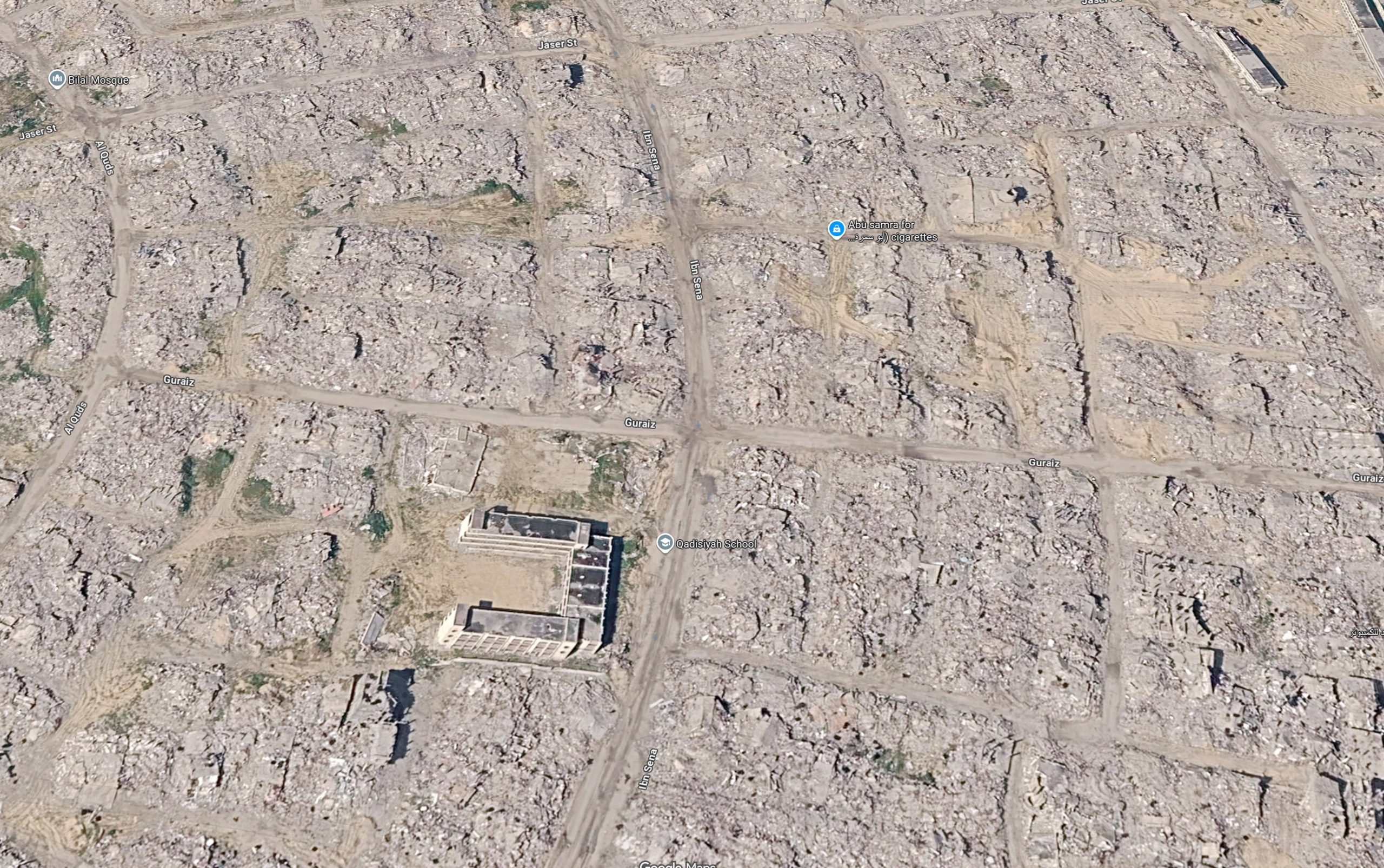
- Google Maps has been updated to show Zionist-holocausted Gaza. This is part of Rafah.
- Google Earth updated the images of Gaza. It’s devastating.
- How in the hell has the world been unable to see this until now, after the damage is done? Google is totally complicit in these crimes, as are the rest of the media.
September 27, 2026-
- Three years of genocide and all SNL has done is make fun of Palestinians and people who protest in support of them. Collin Jost and Michael Che especially just can’t get enough of laughing at the suffering on display in Gaza. Their hands are forever blood stained.- Mocking atrocities is the other psy-op to deflect from genocide.
- The UN officially declared the Gaza Strip a genocide zone, stating that Israel is deliberately targeting children and infants. It took the UN three full years to reach this conclusion.