
This post has been read 308 times!
 June 24, 2026- by Steven Greer
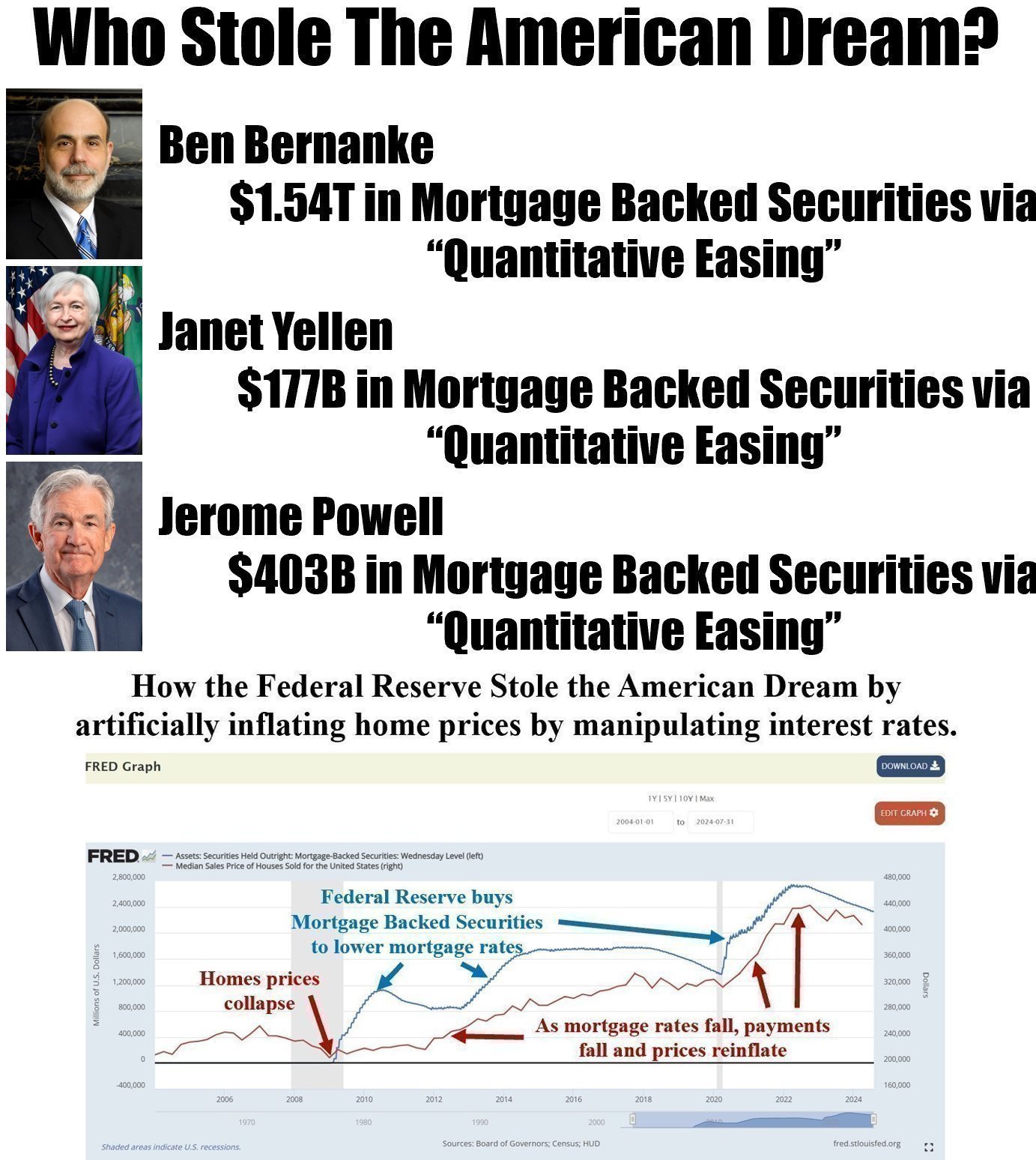
Someone posted this image. Let me explain.
The Federal Reserve controls monetary policy, which is separate from fiscal policy managed by Congress and the President through taxes and spending.
Quantitative easing is essentially printing brand new money. The Fed creates dollars electronically out of thin air and uses them to buy financial assets. This directly increases the money supply and puts more dollars into the economy.
The graphic accuses three Fed Chairs of abusing this power and stealing the American Dream of homeownership.
It shows that Ben Bernanke purchased $1.54 trillion in mortgage-backed securities, primarily during the first round of quantitative easing from late 2008 through 2010 in response to the financial crisis.
Janet Yellen oversaw $177 billion in additional purchases, mostly during the later stages and tapering around 2014.
Jerome Powell bought $403 billion, with the bulk occurring during the massive pandemic-era quantitative easing program from March 2020 through early 2022.
By using this newly created money to buy trillions of dollars in mortgage-backed securities, the Fed deliberately pushed mortgage interest rates much lower. Lower rates made monthly house payments cheaper for any given loan size, which allowed buyers to qualify for larger mortgages and bid more aggressively on homes. With housing supply relatively fixed in the short term, this flood of new money and extra demand caused home prices to inflate sharply.
The FRED chart at the bottom of the graphic illustrates this clearly: home prices crashed in 2008–2009, but then rose dramatically as the Fed ramped up its purchases, with especially steep increases after 2012 and again after 2020.
Printing money through quantitative easing created a classic inflationary bubble in the asset class of houses. The new money had to flow somewhere, and it flowed heavily into real estate, driving up prices far beyond what wages and organic economic growth could support.
This is no different from what we are seeing right now. Under Chairman Powell, the Fed has continued large-scale money creation, even if much of it has been in stealth mode, and that excess liquidity is now pouring into the equity and stock market.
This explains why we have multiple companies with multi-trillion-dollar market caps. Free money always has to go somewhere, and it inevitably ends up inflating asset-class bubbles, whether in housing, stocks, or other financial assets.
None of this occurred by accident or mere incompetence. It was by design.
Since the creation of the Federal Reserve in 1913, and other central banks, the real wealth of the average citizen has steadily declined while the influence of powerful banking families and financial elites has expanded dramatically. The ability to print money and engineer inflation serves as a potent tool for economic subversion: it erodes savings, distorts markets, and ultimately allows insiders to acquire real assets at depressed prices after the inevitable busts.
This is precisely what we are witnessing today, as inflation quietly transfers wealth from the middle class to those who already own substantial property and hard assets. The result is a deliberate hollowing out of broad-based prosperity that benefits only the wealthy few.
Far from random policy errors, these patterns reflect a long-term strategy that concentrates power and property in ever-fewer hands.