
This post has been read 254 times!
 Title: From Synthetic DNA and RNA-Based Self-Assembling Nanotechnology to Sequalae of COVID-19 Shots
Authors:
- Shimon D. Yanowitz (Electrical Engineer, Independent Researcher, and Associate Editor for IJVTPR, Haifa, Israel)
- Daniel Broudy (Professor of Applied Linguistics, Okinawa Christian University, Nishihara-cho, Okinawa, Japan, and Associate Editor of IJVTPR)
Publication: International Journal of Vaccine Theory, Practice, and Research, Volume 4, Issue 2, pp. 1701–1753 (2026). DOI: https://doi.org/10.56098/7mhh1467 (published June 19, 2026).
June 27, 2026- by Steven E. Greer, MD
This paper reveals an advanced technology of which most people are unaware. The COVID-19 so-called “vaccines” were not traditional vaccines. They were a form of gene therapy that used protective lipid nanoparticles (liposomal envelopes) to deliver synthetic genetic material, either modified messenger RNA or, in some analyses, residual circular plasmid DNA, directly into the cells of billions of recipients.
Officially, this material was designed to instruct cells to produce the SARS-CoV-2 spike protein, mimicking the virus in order to trigger immunity. That was bad enough, if all there was to it, because the spike protein itself is highly problematic and pathogenic. It promotes clotting, vascular damage, and inflammation, making its use as a vaccine antigen inherently dangerous.
However, this paper goes much further. It explains that DNA and RNA are not merely genetic code for proteins or replication. They are versatile programmable construction materials at the nanoscale. Through techniques like DNA origami, researchers design long scaffold strands and short staple strands that self-assemble into precise 2D and 3D microstructures, functioning as molecular scaffolds. These can be engineered with atomic precision to serve as templates for building more complex assemblies, incorporating other molecules, nanoparticles, or electronic components. Once inside the body, this synthetic genetic machinery can direct cells (or operate cell-free) to produce, fold, and grow hierarchical structures that scale from nanometers to visible microscopic and even macroscopic entities.
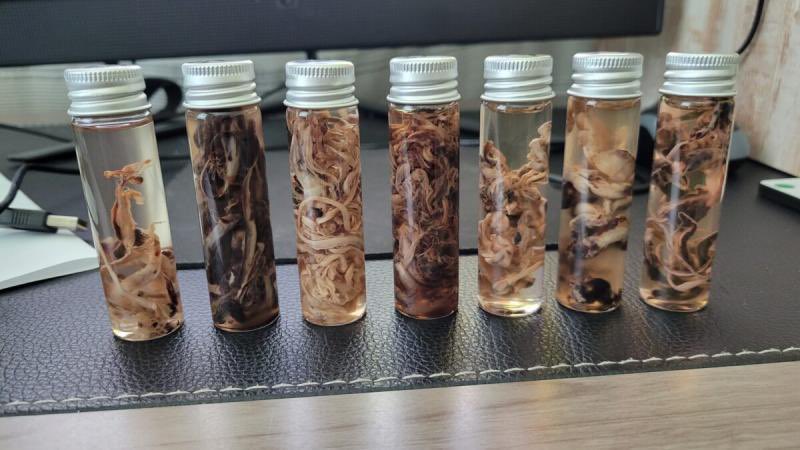
Forensic microscopy cited in the paper shows self-assembling entities forming in real time in both vial contents and the blood of injected individuals. These include ribbon-like fibers, parasitic-looking forms, lattices, and larger aggregates. Many researchers and embalmers link these to the anomalous “white clots” (i.e., the tough, rubbery, fibrous structures unlike normal blood clots that have been found extensively filling arteries and veins in cadavers and living patients). The paper argues these are not ordinary thrombi made of blood cells and fibrin, but products of this synthetic nanotechnology: self-assembling, resource-harvesting microstructures that disrupt tissues mechanically and biochemically.
The authors connect the self-assembling entities observed via forensic microscopy to broader developments in materials science, bioengineering, and neurotechnology. They reference Body Area Networks (BANs or Wireless BANs), which are networks of wearable or implantable sensors standardized under IEEE 802.15.6 for low-power, secure communication near or inside the human body. They also discuss the Internet of Bio-Nano Things (IoBNT), an extension of the Internet of Things that envisions nanoscale bio-engineered devices operating inside living systems, communicating via molecular or electromagnetic signals and interfacing with external digital networks for sensing, actuation, and control. Additionally, the authors link these observations to DARPA’s Next-Generation Nonsurgical Neurotechnology (N3) program and neuroethicist James Giordano’s discussions of nonsurgical brain interfaces. N3 aims to develop injectable nanomaterials for high-performance brain-computer interfaces that can read from and write to neural activity without surgery, while Giordano has publicly addressed the potential for such technologies in future warfare, including brain invasion, modulation, and disruption using advanced neurotools. Together, these frameworks frame the injected synthetic entities as potential building blocks for internal bio-electronic networks capable of surveillance, resource harvesting, or neurological control.
In summary, what was injected in the COVID shots may enable far more than spike protein production. It potentially deploys programmable, self-replicating synthetic biology capable of building persistent microstructures inside the human body, with devastating observed sequelae. The paper calls for urgent research into safe ways to clear these synthetic entities.